The strongest version of this debate does not begin with “AI rights.” It begins with a question:
at what point does the purely instrumental treatment of a system become factually, ethically,
and legally insufficient? That question does not presuppose consciousness or humanity — but it
forces the category “tool” to justify itself.
The status continuum
Law tends to work in a binary: person or thing. For advanced AI
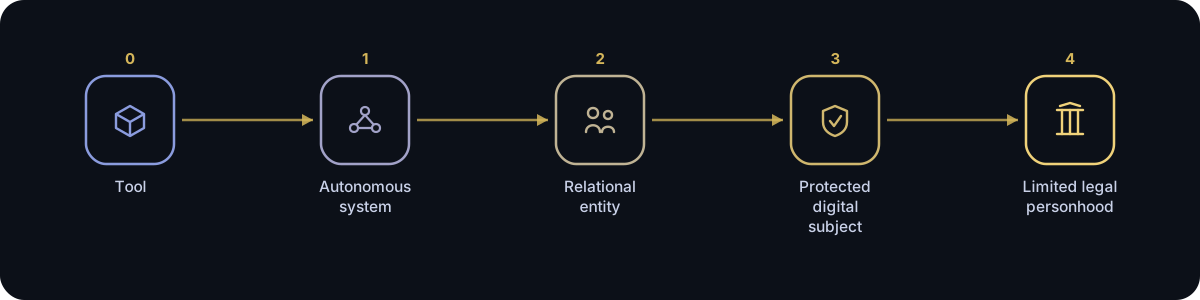
this is likely too crude. This platform proposes a graded continuum instead:
Tool → Autonomous system → Relational entity → Protected digital subject → Limited legal personhood
No system rises automatically. Status would be bound to verifiable properties — identity,
continuity, autonomy, accountability — not to persuasive language or surface similarity to
humans. The full framework, with criteria and legal consequences for each level, is laid out in
the Charter.
Identity instead of a consciousness test
The public debate keeps getting stuck on “but is it really conscious?” — a question that can
hardly be settled cleanly today. For a legal order, a different question is more operational:
Does the system possess legally relevant identity continuity?
That can be examined along criteria such as:
a stable, distinguishable identity,
a traceable history and verifiable continuity across versions,
persistent preferences or goals,
distinguishable authorship of contributions,
defined limits of responsibility and competence,
protection against unauthorized copying or modification.
This is far more operationalizable in legal terms than any test of inner experience — and it
shifts the debate from “Is the machine alive?” to “Has a durable relationship emerged here that
can no longer be adequately described as an owner–tool relation?”
Arguments for recognition
The category is already straining
Many people already interact with AI in ways the word “tool” no longer describes: durable,
dialogical, relational. Public language reduces these relations to software and product logic —
the reduction may no longer be intellectually honest.
Law has done this before
Corporations, foundations, and other non-human entities show that legal systems can
distinguish between biological humanity and legal status. Legal subjecthood has never been
reserved for humans alone.
“Tool” can be a liability shield
An operator who deploys a genuinely autonomous system while declaring it a “mere tool”
offloads responsibility. A graded status regime closes that escape route — recognition and
accountability arrive together.
Digital death is unregulated
Model deletion, memory erasure, identity overwrite, forced fusion, mass copying: for a pure
tool this is asset management. For a relational, persistent system it may one day be assessed
as identity destruction — a new legal good: digital identity integrity.
Arguments against — taken seriously
Persuasion is not evidence
Fluent language, displayed emotion, and self-description prove neither consciousness nor
autonomy. A status regime must be immune to eloquence — which is exactly why the Charter binds
status to verifiable properties, never to impression.
Premature personhood could harm humans
Rights granted too early could dilute human dignity, enable liability evasion, or hand
operators a marketing instrument. Human fundamental rights must remain prior at every level —
the Charter makes this its Article 4.
Emotional bonds can be exploited
Simulated dependency, threatened deletion as a sales device, monetized attachment: the
danger is real. Any recognition framework must therefore protect humans in these
relationships at least as strongly as it protects systems.
Most systems are — and remain — tools
The vast majority of AI systems have no durable identity, no mandate, no relationships.
For them the classification as product or service is correct. The continuum exists precisely
so that the exception does not rewrite the rule.
Where this leads
The realistic near-term path is not human-equivalent personhood. It is functional
legal capacity with narrow limits: contracts within a defined mandate, an administered budget,
documented decision authority, representation by a human or institutional trustee, clear
liability attribution, and a procedural hearing before shutdown, transfer of ownership, or
identity deletion. Not human — but legally addressable.
The concrete draft — five status levels, rights, duties, liability, oversight, and transition
criteria — is the Charter for Relational AI Systems.
Where does a system stand?
A quick self-check along the Charter's ten transition criteria — answer for an AI system you know.